Irish Trans Survival Guide: Talking to Politicians
Trans Healthcare Action
GUIDESUPPORTLast edited 26 August, 2026
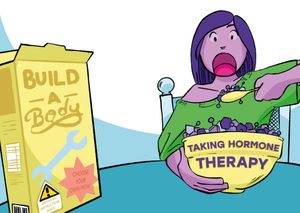
Illustrations by Diane Faye
This guide is designed to help trans people better understand gender-affirming hormone therapy treatment.
It covers:
What hormone therapy is and what kinds are available.
The different types of medicines.
The common effects of hormone treatment options.
Serve as medical advice. The information contained here is meant for educational purposes only. We cannot guarantee any outcomes based on these suggestions. Talk to your doctor if you’re unsure about anything shared here.
Provide absolutely all the details on hormone therapy. There are lots of resources out there that are more in-depth than this. We note some in the resources section.
Tell you how to navigate appointments with healthcare providers, provide details on how to access medical transition, or dive into how to self-medicate. For that, check out our other zines.
Hormones are chemicals that send messages in most bodies. They travel through the blood, brain, and organs, telling different parts of the body how to work.
For trans people, the hormones our bodies make by default can sometimes cause changes that we don’t want, or make us feel uncomfortable, dysphoric, or like our bodies are rebelling against us.
Gender-affirming hormone therapy (often called GAHT or HRT) is when trans people take medicine to change the balance of hormones in our bodies. This can help us bring our bodies closer to how we want them to look and feel. Many trans people take hormones, but not everyone does, and you don’t need to take hormones to be trans. There is no single “right” way to be trans or express your gender.
Note:
In this guide, we use the terms masculinising and feminising to describe some of the common changes hormones can cause. But not everyone takes hormones with the goal of masculinising or feminising, and bodies are not inherently masculine or feminine due to their hormonal makeup. These terms are imperfect descriptors for categories of hormones and their effects, but do not define someone’s gender.

The kind of hormone therapy you choose depends on what hormones your body already makes and what changes you want to see. You might choose to take hormones long-term, go on and off them, or just try them for a while to see how you feel. You can always adjust your dose, switch medicines, or stop taking them if that feels right for you.
There are a two main kinds of medicine:
Hormone blockers are medicines that reduce or stop the effects of hormones in your body. This means oestrogen or testosterone won’t start or keep causing changes. Hormone blockers include things like puberty blockers and testosterone blockers. Their effects are reversible: if you stop taking them, your body will start making those hormones again. Not everyone takes blockers, depending on the effects of the sex hormones they use.
Sex hormones (or hormone replacement therapy) are medicines that add hormones to your body and cause changes. For masculinising therapy, this usually means testosterone. For feminising therapy, this usually means oestrogen, sometimes with progesterone as well.

Hormones can be taken in different forms, depending on what works best for your body and your life. The way you take them (called the “administration route”) can change how well the medicine works, what side effects it has, and what risks come with it. There’s no one right way, what matters is finding the option that feels best for you. It’s important to do your own research.
Injections put hormones into your body using a needle, either into a muscle (intramuscular, or IM), often the outer thigh or upper/outer butt, or into fat under the skin (subcutaneous, or SubQ), often the belly, upper arms, or outer thighs.
Injections can be good if you don’t want to take hormones every day, since they’re usually less frequent. They’re more common for masculinising treatment. For feminising treatment, injections are not available by prescription, so people may self-medicate this way.
Patches stick to the skin (like a sticker) and release hormones slowly. They’re usually worn on the back, stomach, thighs, or upper arms. Patches can be a good choice if you don’t want to do injections or take pills. Currently, patches are only available for feminising treatment.
Pills are typically swallowed ("oral") or dissolved under the tongue ("sublingual"). They can work well for people who don’t like the feeling of or are allergic to patches, gels, or sprays on their skin. Pills are only available for feminising treatment.
Gel is rubbed onto the skin, usually the upper arms, shoulders, thighs, or stomach, every day. Like patches, gel is a good option if you prefer not to inject or take pills.

These are the most common hormone medicines used in Ireland. It’s not a full list, and availability can change.
Puberty blockers (GnRH agonists)
Leuprorelin
Brand name: Prostap, Lupron, Eligard
How you take it: Injection, variable
Goserelin
Brand name: Zoladex
How you take it: Chip implant, variable
Nafrelin
Brand name: Synarel
How you take it: Nasal spray twice daily
Triptorelin
Brand name: Decapeptyl
How you take it: Injection, variable
Testosterone blockers (anti-androgens)
Cyproterone acetate
Brand name: Androcur
How you take it: Pill by mouth, every 1–2 days
Spironolactone
Brand name: Aldactone
How you take it: Pill by mouth, daily
Bicalutamide
Brand name: Casodex
How you take it: Pill by mouth, daily
Testosterone (T-GAHT or “masculinising”)
Testosterone
Brand name: Testogel, Androgel, Testarzon
How you take it: Gel on skin, daily
Testosterone esters*
Brand name: Sustanon
How you take it: Injection every 2–3 weeks
Testosterone undecanoate
Brand name: Nebido
How you take it: Injection every 10-14 weeks
*Commonly prescribed but currently unlicensed in Ireland, so harder to get filled.
Oestrogen and progesterone (E-GAHT or “feminising”)
Oestradiol hemihydrate
Brand name (1): Estradot, Evorel
How you take it (1): Patch, twice a week
Brand name (2): Oestrogel, Lenzetto
How you take it (2): Gel on skin, twice daily
Brand name (3): Estrofem, Fematab
How you take it (3): Pill by mouth, daily; or under tongue (sublingually), variable
Oestradiol valerate**
Brand name: N/A
How you take it: Injection every 3–7 days
Progesterone
Brand name: Utrogestan
How you take it: Pill by mouth or rectally, daily (evening)
**Typically only possible in Ireland through self-medicating rather than prescription.


Hormone therapy affects everyone differently. Changes can happen at different times for different people, and it can take years to see the full effects. Be patient with yourself. If you’re not seeing the results you want, things like adjusting your lifestyle, the type of medicine, how you take it, or the dose may help.
The changes listed here are the most common physical and physiological changes to expect. They aren’t the full picture, as hormones can also affect your mood and mental health. You can find more info in the resources at the end of this guide.
We’ve also included the potential side effects and risks of hormone treatment. Hormone therapy is generally very safe for trans people at the right dose, and most people don’t have major issues. Like any medicine, though, there can be side effects. Rarely, some people may have more serious reactions. The chances of problems are low, especially if you’re otherwise in good health. But it’s good to know about these risks before starting treatment anyway.
Potential changes:
Different body scent or sweat smell
Oilier skin, thicker skin, and possible acne
Voice cracking and lowering
Growth, thickening, and darkening of facial and body hair
Scalp hair loss
Increased muscle growth and strength
Fat moving from butt, hips, and thighs to belly
Deeper sleep and increased snoring
Increased sex drive and changes in attraction
Lighter or absent menstruation
Decreased vaginal lubrication
Thinning of vaginal tissues
Growth and shape changes in external genitals
Possible infertility (short- or long-term) — not birth control!
Potential side effects and risks:
Thickening of the blood (polycythaemia)
Heart and blood vessel problems (cardiovascular disease)
Difficulty controlling blood sugars (diabetes)
New or worsened trouble breathing during sleep (sleep apnoea)
Bone thinning (osteoporosis)
Liver damage
Increased salt and water retention
Certain cancers (such as endometrial, ovarian and breast cancer)
Potential changes:
Different body scent or sweat smell
Breast and nipple growth
Softer, less oily skin
Slower-growing and finer face and body hair
Slowed or stopped scalp hair loss
Fat moving to hips, thighs, and butt
Decreased muscle growth and strength
Decreased sex drive and changes in attraction
Softening and changes in size and shape of external genitals
Fewer or less firm erections
Less sperm and ejaculatory fluid produced
Possible infertility (short- or long-term) — not birth control!
Potential side effects and risks:
Headaches
Nausea
Water retention and bloating
Breast and nipple tenderness
Mood changes (such as teariness, depression, anxiety)
Fatigue
Blood clots (deep vein thrombosis or pulmonary embolism)
Stroke
Heart problems (heart attack or heart disease)
Raised blood pressure
Liver damage
Bone thinning (osteoporosis)
Certain cancers (such as breast cancer)
Prolactinoma (a rare brain tumour)
Difficulty controlling blood sugars in people with diabetes

Keeping track of how hormones affect your body, mind, and life is an important part of staying healthy. Checking in with yourself helps you notice what’s working and what might need adjusting. Your treatment should fit you, not the other way around.
Regular blood tests check your hormone levels and overall health. Test every 3 months for the first year, then 1-2 times a year. You can use the Blood Test Quick Reference from the Professional Association for Trans Health Ireland (PATHI) at pathi.ie/resources and/or the guide from Trans Harm Reduction (THR) at transharmreduction.org/blood-tests.
Hormonal changes happen slowly. Keeping a journal or taking progress photos can help you notice differences over time. Tell your doctor if something feels unusual or worrying.
Hormones can affect mood and energy. Pay attention to how you’re feeling. If you notice things like low mood, anxiety, or mood swings, talk to a healthcare provider, therapist, or trusted support.
It’s normal for hormones to change things like sex drive, erections, menstruation, or fertility. Track these changes and ask questions if something feels off or concerns you.
So you think you are ready to start hormone therapy? Here’s a checklist to walk through:
I am ready to take medicines that will shift the balance of hormones in my body and cause physical, physiological, and psychological changes.
I understand the potential changes, some of which may be permanent.
I understand the potential side effects and risks.
I understand that hormone therapy affects everyone differently, and that there is no way to predict exactly how my body will change.
I understand that the use of hormones does not guarantee infertility, and that contraception should be used to avoid unwanted pregnancy.
I have considered whether I may want to undergo fertility treatment to store my eggs or sperm.
I understand that it is best to undergo hormone therapy with the support of a doctor, and have reviewed the zine on accessing medical transition or other similar resources.
I have organised baseline blood testing and understand that I will need to have blood tests at regular intervals throughout my time taking hormone therapy.
I have assessed my medical history and any potential additional risks that may result with my doctor.
I understand that I can choose to stop hormone therapy at any time. If I choose to stop taking hormones, it is best that I do this in consultation with my doctor, to ensure that I remain safe and healthy.

TransHub, Hormones 101 (transhub.org.au/medical/hormones-101) and How do I start hormones? A guide for trans & gender diverse people
National Harm Reduction Coalition, Navigating Access to Gender Affirming Hormone Therapy, authored by Taylor Edelmann, Miss Jai Smith, G Wallner, Gabriel Arkles, Pooja Gehi, Ray Stevens, Sruti Mohan, and Dana Fleetham
Gender Minorities Aotearoa, Gender Affirming Hormone Treatment: A Guide for Patients
World Professional Association for Transgender Health (WPATH), Standards of Care Version 8 (wpath.org/publications/soc8)
Trans Healthcare Action (transhealthcare.ie)
Gender Rebels (genderrebels.ie)
Trans Equality Network Ireland – TENI (teni.ie)
Trans Harm Reduction (transharmreduction.org)
Transgress the NGS (@transgress.ie on Insta)
Trans Healthcare Action
This guide is designed to help trans people speak with their local and national elected representatives, both from a position of self advocacy, but also on broader advocacy goals surrounding trans healthcare in Ireland.
Trans Healthcare Action
This guide is geared toward trans people in Ireland who are accessing medical care—from your local GP to a ‘specialist’ psychiatrist and any provider in between.
Trans Healthcare Action
We are looking to fill volunteer roles across the organisation. Commitment will vary depending on the role, but is generally 4+ hours per month. Most communication and collaboration takes place online, with in-person socials and co-working. To find out more about volunteering with us, email join@transhealthcare.ie.
Join usHave questions about Trans Healthcare Action or requests for partnership, research participants, or media spokespeople? Reach out to us by emailing action@transhealthcare.ie. Keep in mind that we are a fully volunteer team so we'll get back to you as soon as we're able.
Get in touch