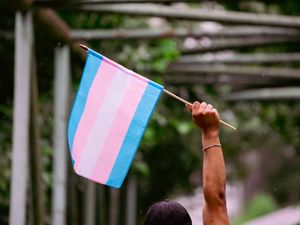
By remaining visible – by refusing to conform to societal pressures – we normalize ourselves in society. What was once “taboo” becomes “disgraceful”, what was once “disgraceful” becomes “inappropriate”, and what was once “inappropriate” becomes “ordinary”. It’s easy to scandalize an individual, but harder to scandalize a demographic. As more of us start living our lives publicly in our local communities, more people get to know us. It de-mystifies us. We are no longer a faceless entity - we are regular, everyday people who go grocery shopping, who work boring jobs, who put out our wheely bins every week. Years pass by, and our neighbours stop thinking of us as “trans”, and start just thinking of us as ourselves. We become another mundane part of everyday life.
Eventually, our visibility gets reciprocated. Not only do we become seen, but our allies show themselves too. With “Trans rights” stickers on public streetlights, pride flags in store windows, or non-binary options on digital forms, the public reassures us that we are not only seen, but supported. Johnny next door doesn’t want to see his neighbour mistreated, the local supermarket doesn’t want customers to feel unwelcome, businesses don’t want good workers to avoid applying. As we become accepted by society, we become valued and encouraged by society.
All of this comes from making ourselves visible. Visibility in and of itself can bring about change. Over time, and across different scales, each and every one of us contributes to shifting societal opinions. Whether you take to the streets and march for healthcare, or quietly build relationships in your community - visibility in the face of adversity is a radical act of resistance. Regardless of your scale, you make an impact on those who see you, and those who get to know you.
For maximum impact, we would urge everyone who is able to speak to their TDs. We live in a democracy, and as such the best way to advocate for change is to make yourself visible to your elected representatives. Show them that “trans rights” isn’t some abstract concept, but a very real issue that is affecting their own constituents. It’s one thing to hear stories of how inadequate our healthcare is in Ireland - but completely different when you can put faces to the people impacted by it. So please, consider finding your local TDs and reaching out to them. Tell them how poor our access to healthcare is, and let them know how the government can help. You could also print out our policy briefs to hand to your TD.
Recent News
See All NewsStatement on our resignation from the model of care for gender healthcare working group
The Year of “Firsts” - Pride 2026
2026 has been a year of growth, development, and new beginnings for queer communities across Ireland. Soon after opening the first peer-led trans health clinic in Ireland, our volunteers got busy planning how to show up and support as many Pride events as possible. While we couldn’t get to every Pride in Ireland, you might have heard us speaking at Trans & Intersex Pride Dublin, picked up printed Trans Survival Guides from our table at Wexford Pride, or saw us representing Kindred at Cork Community Pride.
Volunteer
We are looking to fill volunteer roles across the organisation. Commitment will vary depending on the role, but is generally 4+ hours per month. Most communication and collaboration takes place online, with in-person socials and co-working. To find out more about volunteering with us, email join@transhealthcare.ie.
Join usEnquire
Have questions about Trans Healthcare Action or requests for partnership, research participants, or media spokespeople? Reach out to us by emailing action@transhealthcare.ie. Keep in mind that we are a fully volunteer team so we'll get back to you as soon as we're able.
Get in touch